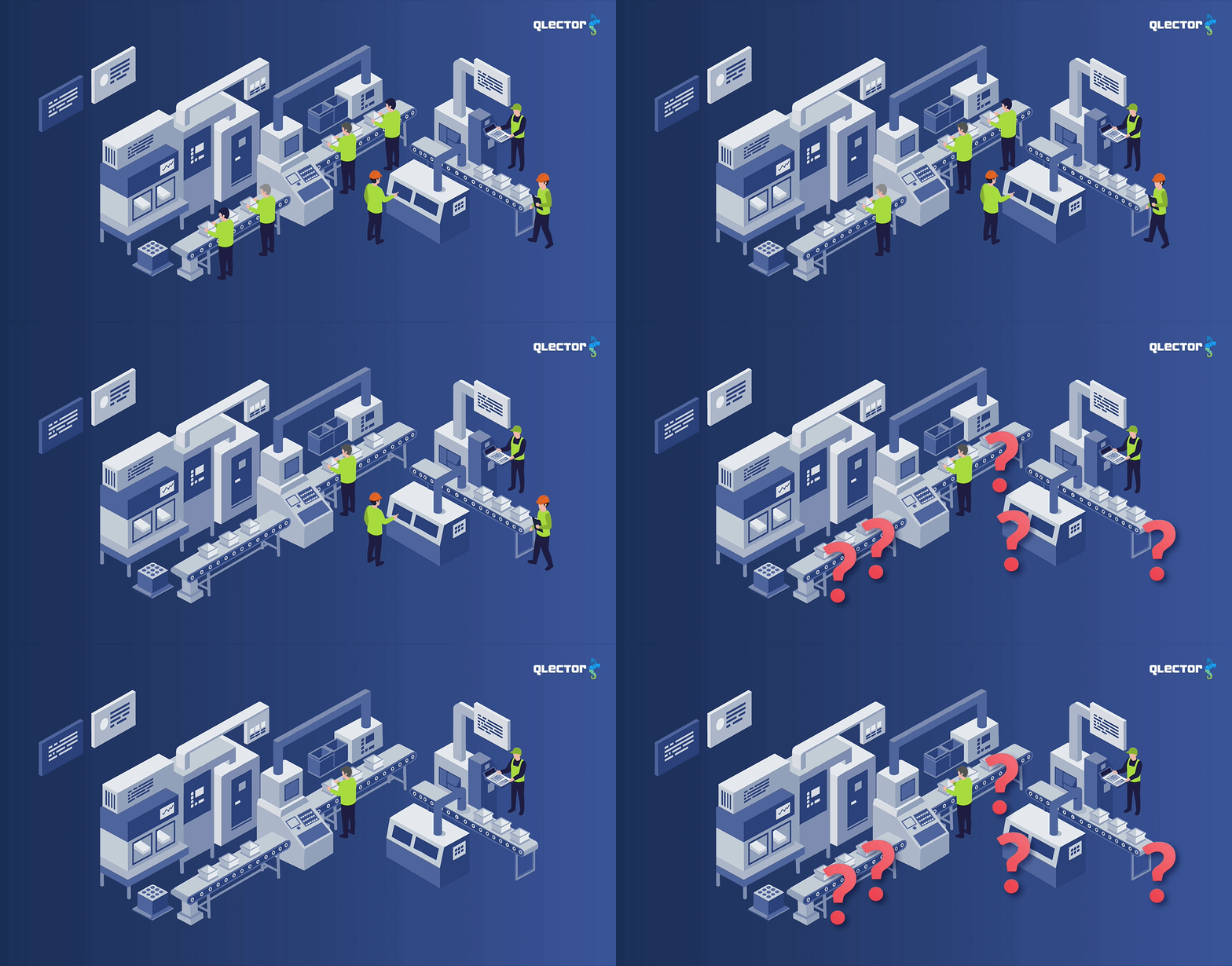
How Leading Manufacturers Use People-First Production Planning to Build Realistic Production Plans Around Their Actual Workforce Capacity
In modern manufacturing, machines define theoretical capacity – but people ultimately determine what is actually possible on the shop floor. People-first production planning introduces a new perspective: planning production around real workforce capacity rather than forcing people to fit predefined plans.
Our newly developed module, Advanced Workforce Scheduling and Worker Exchange, brings this concept into practice. By integrating data from HR and ERP systems and tracking competencies and attendance, the module provides planners with a clear overview of workforce availability. It enables transparent worker exchange between departments in cases of workforce surplus or shortages, helping manufacturers respond faster to absences and reduce operational friction.
Workforce as the Real Constraint
In many manufacturing environments, production planning still follows a traditional logic: production plans are defined first, and available workers are then allocated to match them.
In practice, this approach often breaks down due to staff shortages, skill gaps, or high absence rates. Production lines that appear feasible on paper may simply lack the necessary competencies on the shop floor.
As a result, planners and supervisors spend significant time coordinating adjustments, searching for suitable replacements, or negotiating workforce availability across departments.
The issue is rarely a lack of data. Most companies already track competencies, attendance, and workstation requirements. The real challenge is turning this information into practical support for daily workforce scheduling decisions.
Introducing People-First Production Planning
While developing advanced worker exchange functionality for a large global manufacturing company in Germany, we introduced the term People-first production planning.
The concept reverses the traditional planning logic.
Instead of defining production plans first and then trying to fit workers into them, companies begin by allocating available workers to production lines, assessing which lines are realistically covered, and then building production plans around actual human capacity.
This shift is becoming increasingly relevant in manufacturing environments where skilled labour is limited, and workforce disruptions are common.
People-first production planning does not replace production planning systems. Rather, it complements them by ensuring that real workforce capacity becomes a central planning parameter.
A System Built on Real Data
The foundation of the system is a unified data layer integrating workforce-related information from existing IT systems.
Through a REST API, the module receives data such as:
- employee master data
- working-time constraints
- confirmed competencies
- attendance and absences
- production lines and workstations
- workstation requirements, including required competencies and the number of workers
Typically, the customer’s IT team or a third-party integration layer ensures that this data is automatically retrieved from ERP and HR systems.
With these inputs consolidated, planners gain a clear and up-to-date overview of workforce availability across shifts and departments.
Workforce Scheduling with a Pool Approach
At its core, the module supports shift-based workforce scheduling using a “pool” approach. Workers available in a shift are considered part of a shared pool from which planners can assign the right competencies to production lines and workstations.
Attendance and absence data are automatically imported from the HR system, giving planners immediate visibility into which workers are available in each shift.
Workers can then be scheduled to production lines based on competencies, availability, and operational constraints. The system supports real-world production scenarios such as:
- production lines requiring multiple roles in a team, for example, operator, mechanic, and electrician
- specialists who support several production lines, such as one mechanic responsible for multiple lines
Scheduling can be performed in multiple stages, combining manual planning with automated scheduling suggestions. Planners can apply filters, evaluate different parameters, and adjust assignments step by step.
This enables simplified communication and coordination on the shop floor, giving planners visibility and the ability to respond quickly when absences are reported.
Warm, known or new?
Manufacturing environments rarely operate with static assignments. Workers rotate between tasks, build experience on different workstations, and operate under various operational constraints.
The system therefore supports:
- tracking “warm-up” and “cool-down” periods
- advanced rotation schemes, for example, staying at one workstation for several working days and then rotating
- rotation between “warm,” “known,” or “new” workstations, depending on worker experience
- the ability to “pin” a worker, allowing supervisors to manually prevent rotations when necessary
At the same time, the system supports worker constraints, such as pre-retirement status or reduced working hours. It also supports organizational and location constraints, determining what each supervisor can see and which production lines belong to the same operational location.
Finally, planners and supervisors can add comments on workers, production lines, and shifts, improving coordination and communication across teams.
An Internal Workforce Marketplace
One of the most distinctive capabilities of the module is the worker exchange mechanism, designed as an internal exchange pool for workforce capacity.
In many factories, one department may temporarily have surplus workers while another department faces higher workloads or unexpected absences.
The system enables a structured exchange process:
- Department A creates its workforce schedule and identifies surplus workers.
- These workers are added to the exchange pool, including shift and role information.
- Department B creates its schedule and identifies a shortage of workers.
- Supervisors search the exchange pool for suitable available workers.
- A reassignment request is submitted.
- Department A confirms the reassignment.
- The worker is scheduled to the open workstation.
- If necessary, the reassignment can also be canceled.
From Absence to Suggested Worker Exchange
Because the system tracks workforce schedules and historical changes, it can also detect patterns over time.
For example, when a worker reports sick leave, the system immediately identifies the resulting gap in the workforce schedule. Based on available competencies and historical exchange patterns, it can suggest possible replacements.
This opens the door for further automation: absence → scheduling gap → suggested worker exchange. Instead of manually searching through workforce lists, planners receive targeted suggestions that accelerate decision-making.
Benefits for Planners and Shop-Floor Teams
For operational teams, the system improves visibility, communication, and the traceability of scheduling decisions. For management, the benefits extend further. Workforce capacity can be balanced more effectively across departments, improving utilization and enabling more flexible production operations.
Reduced coordination effort, fewer operational bottlenecks, and more realistic production plans ultimately translate into higher productivity and less stress for both planners and shop-floor teams.
Get Your Free People-First Planning Consultation
What would your production plans look like if they were built around the workforce you actually have? Get in touch to discover how Qlector LEAP enables People-first production planning on the shop floor.