
At Hannover Messe 2026, one thing was impossible to ignore: absolutely everyone was talking about AI agents.
Tech giants like SAP, Microsoft, AWS, and Salesforce all placed Agentic AI at the center of their manufacturing vision. The message was loud and clear: the next phase of industrial software is reserved for autonomous decision support.
But after speaking with dozens of manufacturing executives and operations leaders, we noticed a major problem: almost everyone seems to define Agentic AI differently.
Some view it as just an advanced chatbot. Others describe it as a glorified digital assistant. A few even imagine fully autonomous robots making decisions completely on their own. The reality sits somewhere in between.
Before manufacturers rush to implement the latest buzzword, there is one critical question to answer: Do we actually understand what Agentic AI is, and is our organization really ready for it?
That is exactly why we wrote this article. We want to cut through the hype, clear up the confusion, and show you what Agentic AI actually looks like in practice, specifically in the most chaotic, high-stakes part of any factory: production planning.
The Hardest Job on the Factory Floor
Imagine being the central nervous system of an entire factory. That is exactly what a production planner is. Their work touches production, sales, buying, and the warehouse. So when the plan is slow or wrong, it sends shockwaves through the entire company’s success.
The job usually has three parts: making the plan, watching the plan, and fixing problems when something goes unexpectedly wrong. Whether a machine suddenly breaks down, a delivery is late, or a priority customer rushes in with an urgent order, the planner is the one who has to resolve it. To do all of this well without burning out, a planner needs agility and a clear view of what is happening.
Is your data working for you, or are you working for your data?
Instead of drowning in spreadsheets, modern planners use two main technologies to make their lives easier on the shop floor:
- Machine Learning (The Numbers): This works with numerical data. It can analyze information, find anomalies, build schedules, and run “what-if” simulations. It is also great for data cleaning, because finding a wrong number early stops bigger mistakes later.
- Large Language Models (The Text): These are tools like ChatGPT. They can summarize text, extract specific information, search by meaning, and answer questions about your own documentation in simple language.
From Simple Workflows to Autonomous Agents
For years, companies have used standard digital workflows to automate simple, repetitive tasks using strict “if-this-then-that” logic. These systems work fine until an exception occurs, instantly requiring a human to step in and figure it out.
But what happens when we add AI into the mix? Suddenly, the process gets a “brain”, allowing the system to understand context, analyze unstructured data, and dynamically suggest the next best action.
In practice, this intelligent automation takes two powerful forms on the factory floor:
First, an agentic workflow uses AI in specific steps to execute tasks. It can trigger on demand or at a specific time. The best part? You can give it instructions in natural language, so a planner can adjust the workflow themselves without needing a programmer.
Second, an autonomous agent goes even further. It is a standalone program that works in a loop to find a solution. It gathers data on its own, has a certain level of autonomy, and asks people for help at the right moments. The smartest agents even build their own skills and learn from past examples.
But what happens when a machine actually breaks?
Example 1: The Unexpected Machine Stop
This is a technical event, but the planner must react fast to minimize the damage. If a planner does this manually, they need to gather data, make a guess in their head or in a spreadsheet, and decide if something must move.
But with AI, you can write these steps once, and they run by themselves next time:
- Look at past stops on this line
- Find similar stops and guess how long this one will take
- Check what happens to the plan if everything moves by a few hours
What once took a planner 10 to 30 minutes to figure out (often happening multiple times a week) is now solved in seconds. But the real value is that the problem stays small, the stress goes away, and the customer never notices.
And what about the repetitive morning chaos?
Example 2: The 7:00 AM Reality Check
Every morning, planners waste precious time reviewing the same things: what the night shift made, if the stock is correct, and if anyone needs a call.
An agent can prepare this check automatically. It can forecast material shortages, analyze inventory, and have everything ready for review. Planners have the flexibility to adjust the context, like watching the most important line or the one material they absolutely cannot run out of. This directly saves 10 to 20 minutes a day and ensures faster action if there are warnings.
Don't fall for the AI hype
Before you start, keep these practical tips in mind:
- Start with the pain: Tie your goals to actual efficiency metrics. Don’t be guided by the vague desire to “do something with AI”.
- Know (and trust) your data: Identify your data streams. Cultivate a culture where data is treated as a core asset.
- Pick the biggest wins: Focus on the 80/20 rule, targeting the situations where the impact will be the biggest.
- Expect exceptions: Let AI cover 90% of the cases, but always leave a manual option for the planner.
- Engage your team: Ensure the active engagement of your end-users. Without their support, the project won’t move forward.
Go Step by Step, But Stay Safe
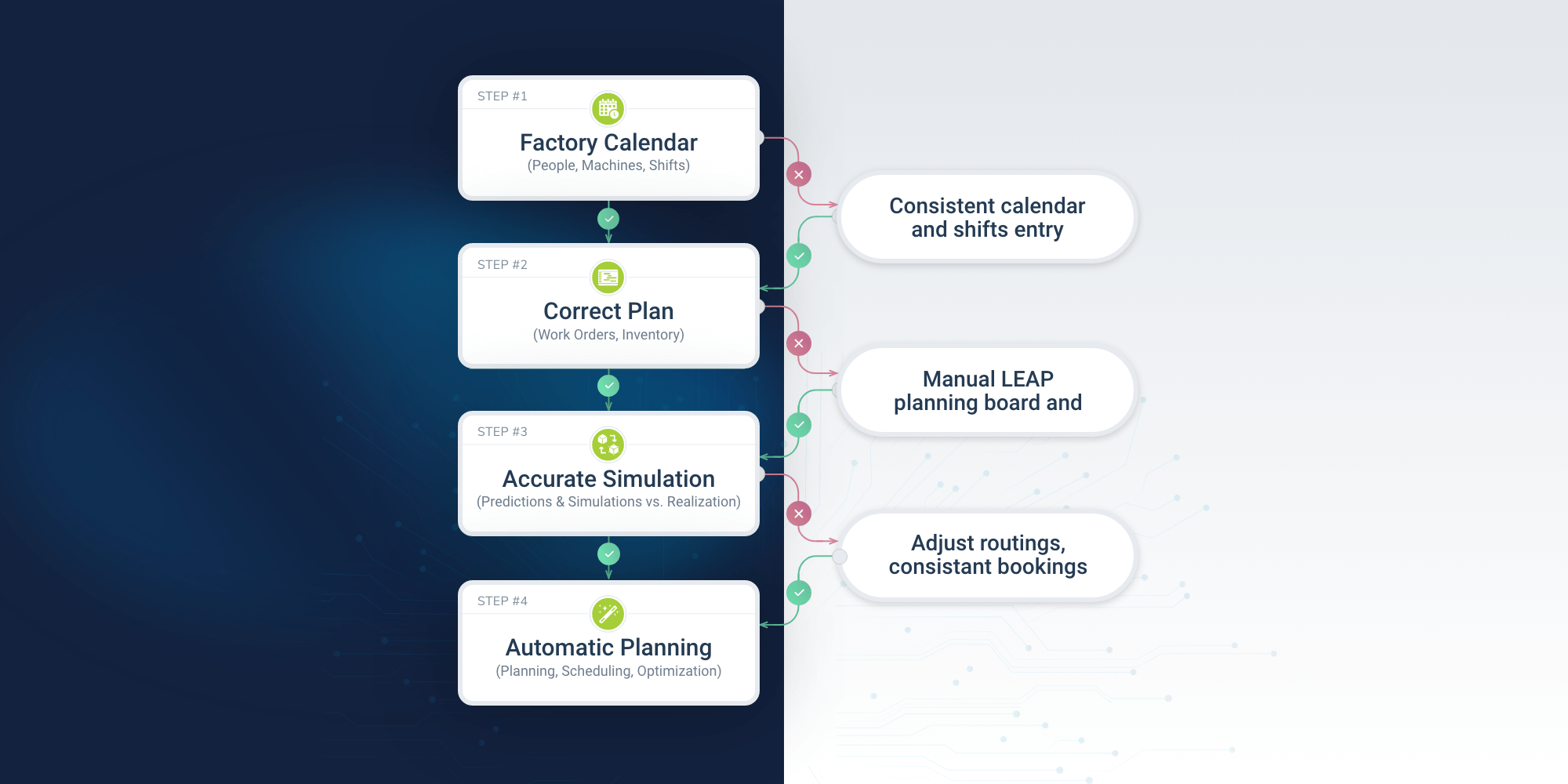
Take it slowly. First, map out the steps and digitalise the process, even if some steps stay manual. Ensure your data is reliable enough to make real decisions, not just reports. Later, give the AI more freedom, step by step, from “show me the data” to “do it for me”.
As agents do more independent work, safety rules are a must.
- Be highly aware of GDPR and data sensitivity.
- Give agents a clearly defined role and framework.
- Set clear rules for when human oversight is required.
- Keep an eye on costs, as AI consumption can add up.
Most importantly, always have a scenario prepared for handling catastrophic errors, including answering the question of who is ultimately responsible.
In short
Agentic AI does not replace the planner. It gives them more time to react and a clearer view, and it can turn a stressful 20-minute problem into one minute. The recipe is simple: start with a real problem, fix your data and process, keep a person in control, and give the AI more freedom only as trust grows.
Let's talk
If any of this sounds familiar, whether it is firefighting stoppages, wrangling endless spreadsheets, or just trying to work out where AI realistically fits into planning, we are always happy to have a conversation.
We would be glad to walk through what it could look like on your shop floor.